

GFC 500 Autopilot Resources
- Details
Our cross country planes will soon have new GFC 500 autopilots. These are really nice additions to N3QZ and N9497M and will really up our game in cross country flying. The new autopilot has a different layout, behavior and features as compared to previous club autopilot installations. This page is intended to provide a set of resources for learning about the GFC 500. An important caveat is that the AFMS that comes with the autopilot installation is the final authority on features and operation. These manual supplements are specific to each plane and contain the specific v-speeds and limitations for those installations. The resources here are provided for general understanding and safe practices when using the GFC 500 (or any autopilot).
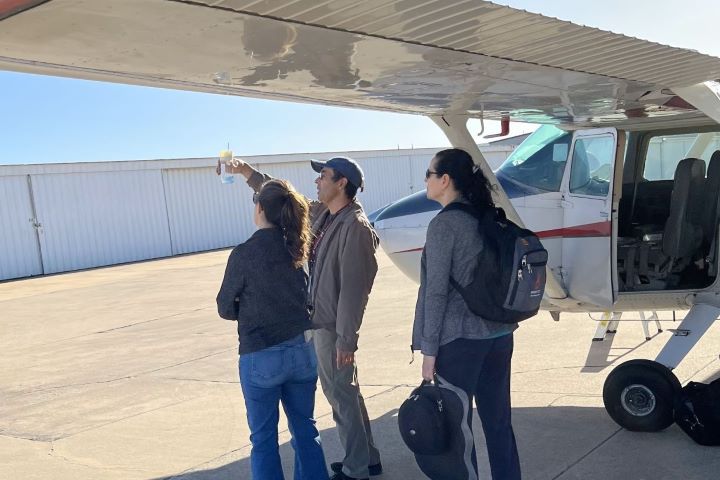
Fuel testing procedures - preflight
- Details
It is now and has been for many years a violation of McKinney Airport rules to dump sumped fuel on the ramp. Doing so also poses significant environmental hazards. Dumping fuel on the ground can be a violation of many airport, city, and state rules. Texins Flying Club equips its planes with tools to safely test and recover fuel samples. This article provides some background and information on procedures club members should exercise for handling fuel sample testing in a safe and responsible manner.

Tire Check and VOR Check Procedures
- Details
Each aircraft contains a dedicated logbook for recording tire checks and VOR checks. Each member should check and record the tire pressure for the first flight of the day. We have tire gauges in each airplane and the correct pressure is written on the wheel struts as well as on the tire gauges. Each airplane has its own specific tire pressure requirement as noted in the POH. If you find the pressure is not correct, you can use the battery operated compressor in the key room to inflate the tires or you can request help from the line attendants to fill the tires. Note that you will need to tell the line attendant the specific pressure to use for each tire. If the tire is over-inflated you can simply release small amounts of air until you have the correct pressure. Also please note that tires pressures will not be accurate if the plane has been flying and moving on the ground, so please only check and adjust the pressure if the plane has been sitting for a long while.
VOR checks? Why do we need those in this age of disappearing VOR's and GPS approaches? Because some of the airports in our immediate vicinity only have VOR approaches and you may need a VOR approach during a GPS outage. VOR checks are good for 30 days - which is not very long. So the best strategy is to always "pay it forward". Do a VOR check whenever you have a chance and record it legally in the VOR log so that it counts for the next pilot. Someday you will be that pilot who needs to lift off in IFR to a VOR only destination like Ennis (F41). Trust me you will appreciate the pilot who flew before you and kept the VOR valid for IFR use.
Gary provided a short video here showing the log. Please use it!
Page 3 of 5